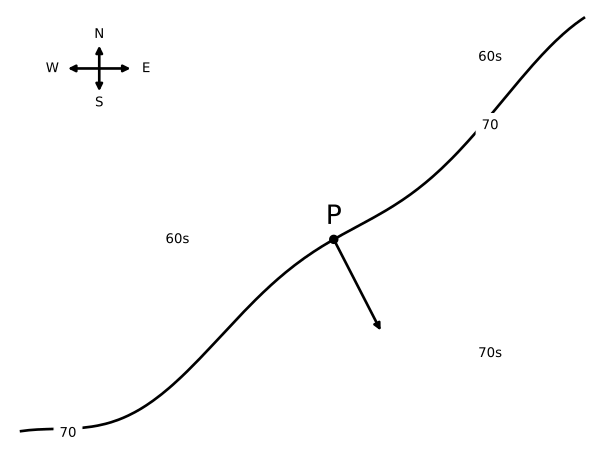
For this activity, we will look at the value of the directional derivative for temperature as a function of location. When looking at a plot of thermoclines (locations with the same temperature), you notice that your town is exactly on the thermocline labeled as 70 degrees, shown as the point \(P\) on Figure 11.7.15
Write a few sentences about why the gradient at \(P\) goes in the southeast direction and not the northwest (which is also perpendicular to the thermocline/ level curve at \(P\)).
Draw a vector in each of the following directions starting at \(P\) and state whether the directional derivative will be positive/negative/0 in each of these directions. You should write a couple of sentences for each direction vector about how the sign of the directional derivative is related to the angle between the direction and the gradient vectors.
Explain what direction you would need to move in to have the greatest positive rate of change for the temperature. Write a couple of sentences to relate your answer to the gradient using Equation (11.7.5).