Activity 12.1.2.
In this activity, we will go through the first two steps of the classic calculus approach to compute the definite integral of \(f(x,y) = 100 - x^2-y^2\) on the rectangular domain \(R = [0,8] \times [2,6]\text{.}\) Remember that we are trying to measure the volume below the graph of \(f\) over the region \(R\text{,}\) so we will start with estimating this volume.
(a)
To understand the numerical calculations involved in the classic calculus approach for a double integral, it is most important to understand the region of integration. Thus, we will not look a graph of \(z=f(x,y)\text{.}\) Instead, we will stay focused in the \(xy\)-plane. On the axes below, outline the rectangular region \(R\) that corresponds to the region of integration.
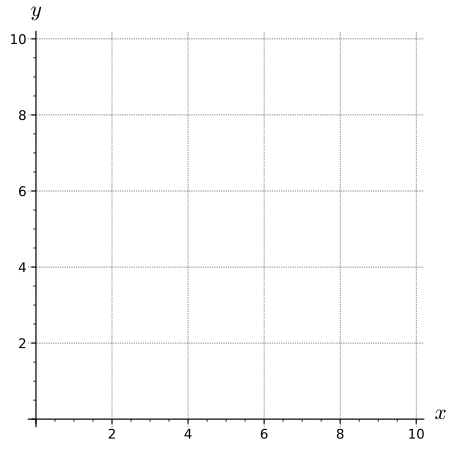
ADD ALT TEXT TO THIS IMAGE
(b)
Because all of the regions and subregions we are considering in this section are rectangles, we can break up the \(x\) and \(y\) coordinates into pieces separately. For this activity, break the interval of \(x\)-coordinates into four equally-sized subintervals and break the interval of \(y\)-coordinates into three equally-sized subintervals.
(c)
Let \(S_i\) be the \(i\)-th subinterval for \(x\text{.}\) We want to state the endpoints of each of the \(S_i\text{.}\) The first subinterval, \(S_1\text{,}\) will go from \(x_0\) to \(x_1\text{,}\) the second subinterval, \(S_2\text{,}\) will go from \(x_1\) to \(x_2\text{,}\) the third subinterval, \(S_3\text{,}\) will go from \(x_2\) to \(x_3\text{,}\) and the fourth subinterval, \(S_4\text{,}\) will go from \(x_3\) to \(x_4\text{.}\)
Give the values for \(x_0\text{,}\) \(x_1\text{,}\) \(x_2\text{,}\) \(x_3\text{,}\) and \(x_4\) and add these as tick marks on the \(x\)-axis of the graph in part a to make sure your subintervals are equally sized.
(d)
Let \(T_i\) be the \(i\)-th subinterval for \(y\text{.}\) Give the values for \(y_0\text{,}\) \(y_1\text{,}\) \(y_2\text{,}\) and \(y_3\) and add these as tick marks on the \(y\)-axis of the graph in part a to make sure your subintervals are equally sized.
(e)
We will use the subintervals in the \(x\)- and \(y\)-coordinates to specify smaller rectangles into which \(R\) is divided to compute an approximation. Let \(R_{i j}\) be the rectangle corresponding to \(S_i \times T_j\text{.}\)
-
How many smaller rectangles are there in this partition?
-
Outline each of the smaller rectangles on the graph in part a and label each rectangle as either \(R_{1 1}, R_{1 2} , ...\text{.}\)
-
Since each smaller rectangle \(R_{i j}\) has the same area, let \(\Delta A\) denote the area of each of these smaller rectangles. What is \(\Delta A\text{?}\)
(f)
To find the volume of the rectangular prisms over each \(R_{i j}\text{,}\) we must pick a point in each subrectangle at which to evaluate \(f\text{,}\) which will be the height of the rectangular prism. For this activity, we will use the upper-right corner of each subrectangle as the designated point.
State the point at the upper right of each smaller rectangle and evaluate \(f\) at each of these points.
(g)
Write a sentence about why the volume of each rectangular prism used for this approximation is
\begin{equation*}
f(x_i,y_j) \Delta A\text{.}
\end{equation*}
Write a couple sentences about how you would find an approximation of the volume under the surface \(z=f(x,y)\) over the region \(R\text{.}\) (Do not do calculation, but rather explain what calculation is being done.)
(h)
We chose the upper-right point of each subrectangle \(R_{i j}\) to find the height of each rectangular prism used in the approximation. Write a sentence or two about whether you think the upper right point provides an overestimate, an underestimate, or approximately the average value for \(f\) on each \(R_{i j}\text{.}\) Explain how this suggests that your estimate for the volume under the surface \(z=f(x,y)\) over the region \(R\) is either an overestimate, an underestimate, or approximately the correct value.

