Skip to main content
Contents Index Calc Dark Mode Prev Up Next \(\newcommand{\R}{\mathbb{R}}
\newcommand{\va}{\vec{a}}
\newcommand{\vb}{\vec{b}}
\newcommand{\vc}{\vec{c}}
\newcommand{\vC}{\vec{C}}
\newcommand{\vd}{\vec{d}}
\newcommand{\ve}{\vec{e}}
\newcommand{\cursedihat}{\hat{\dot{i}}}
\newcommand{\vi}{\hat{\imath}}
\newcommand{\vj}{\hat{\jmath}}
\newcommand{\vk}{\hat{k}}
\newcommand{\vn}{\vec{n}}
\newcommand{\vm}{\vec{m}}
\newcommand{\vr}{\vec{r}}
\newcommand{\vs}{\vec{s}}
\newcommand{\vu}{\vec{u}}
\newcommand{\vv}{\vec{v}}
\newcommand{\vw}{\vec{w}}
\newcommand{\vx}{\vec{x}}
\newcommand{\vy}{\vec{y}}
\newcommand{\vz}{\vec{z}}
\newcommand{\vzero}{\vec{0}}
\newcommand{\vF}{\vec{F}}
\newcommand{\vG}{\vec{G}}
\newcommand{\vH}{\vec{H}}
\newcommand{\vR}{\vec{R}}
\newcommand{\vT}{\vec{T}}
\newcommand{\vN}{\vec{N}}
\newcommand{\vL}{\vec{L}}
\newcommand{\vB}{\vec{B}}
\newcommand{\vS}{\vec{S}}
\newcommand{\proj}{\text{proj}}
\newcommand{\comp}{\text{comp}}
\newcommand{\nin}{}
\newcommand{\vecmag}[1]{\left\lVert #1\right\rVert}
\newcommand{\grad}{\nabla}
\newcommand\restrict[1]{\raise-.5ex\hbox{$\Big|$}_{#1}}
\DeclareMathOperator{\curl}{curl}
\DeclareMathOperator{\divg}{div}
\newcommand{\lt}{<}
\newcommand{\gt}{>}
\newcommand{\amp}{&}
\definecolor{fillinmathshade}{gray}{0.9}
\newcommand{\fillinmath}[1]{\mathchoice{\colorbox{fillinmathshade}{$\displaystyle \phantom{\,#1\,}$}}{\colorbox{fillinmathshade}{$\textstyle \phantom{\,#1\,}$}}{\colorbox{fillinmathshade}{$\scriptstyle \phantom{\,#1\,}$}}{\colorbox{fillinmathshade}{$\scriptscriptstyle\phantom{\,#1\,}$}}}
\)
Activity 12.3.3 .
In this activity, we will be breaking the region
\(D\) from the previous example into parts which are horizontally or vertically simple.
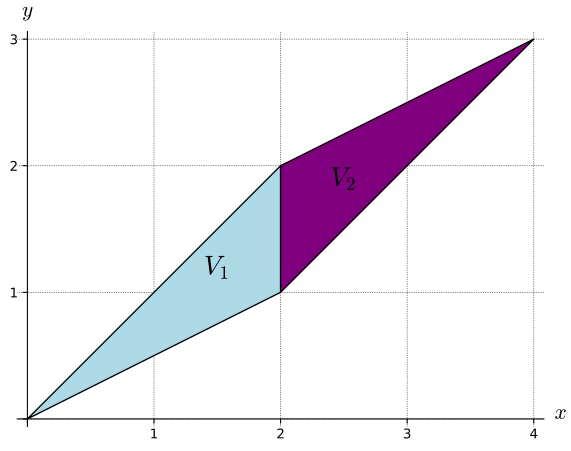
(a) In
Figure 12.3.15 , we have broken our region
\(D\) into two regions
\(V_1\) and
\(V_2\text{.}\) Give inequalities for each of
\(V_1\) and
\(V_2\) that shows that they are individually vertically simple.
The region
\(D\) split into two regions,
\(V_1\) and
\(V_2\text{,}\) which are individually vertically simple
Figure 12.3.15. The region \(D\) split into two regions, \(V_1\) and \(V_2\text{,}\) which are individually vertically simple
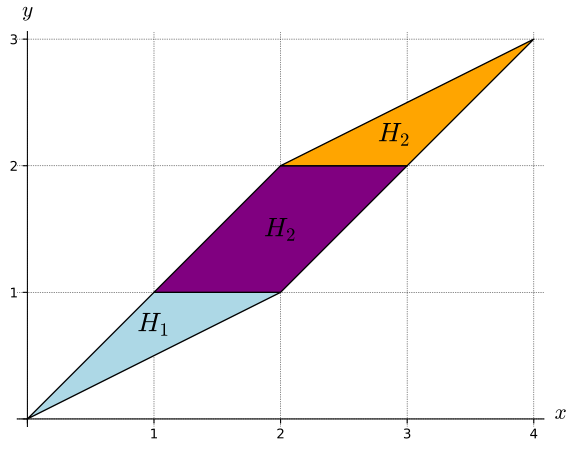
(b) In
Figure 12.3.16 , we have broken our region
\(D\) into three regions
\(H_1\text{,}\) \(H_2\text{,}\) and
\(H_3\text{.}\) Give inequalities for each of
\(H_1\text{,}\) \(H_2\text{,}\) and
\(H_3\) that shows that they are individually horizontally simple.
The region
\(D\) split into three regions,
\(H_1\text{,}\) \(H_2\text{,}\) and
\(H_3\text{,}\) which are individually horizontally simple
Figure 12.3.16. The region \(D\) split into three regions, \(H_1\text{,}\) \(H_2\text{,}\) and \(H_3\text{,}\) which are individually horizontally simple