Preview Activity 12.3.1.
A tetrahedron is a three-dimensional figure with four faces, each of which is a triangle. A picture of the tetrahedron \(T\) with vertices \((0,0,0)\text{,}\) \((1,0,0)\text{,}\) \((0,1,0)\text{,}\) and \((0,0,1)\) is shown in Figure 12.3.1. If we place one vertex at the origin and let vectors \(\va\text{,}\) \(\vb\text{,}\) and \(\vc\) be determined by the edges of the tetrahedron that have initial point at the origin, then a formula that tells us the volume \(V\) of the tetrahedron is
\begin{equation}
V = \frac{1}{6} \lvert \va \cdot (\vb \times \vc) \rvert\text{.}\tag{12.3.1}
\end{equation}
(a)
Find the components of the vectors \(\va\text{,}\) \(\vb\text{,}\) and \(\vc\) used for the tetrahedron \(T\text{.}\) Use these vectors in formula (12.3.1) to find the volume of the tetrahedron \(T\text{.}\)
(b)
Instead of memorizing or looking up the formula for the volume of a tetrahedron, we can use a double integral to calculate the volume of the tetrahedron \(T\text{.}\) To see how, notice that the top face of the tetrahedron \(T\) is the plane whose equation is
\begin{equation*}
z = 1-(x+y)\text{.}
\end{equation*}
We will evaluate a pair of iterated integrals on on a non-rectangular region to calculate the volume of the region below this plane and in the first octant. (Recall that the first octant is the part of \(\mathbb{R}^3\) that has positive \(x\)-, \(y\)-, and \(z\)-coordinates.)
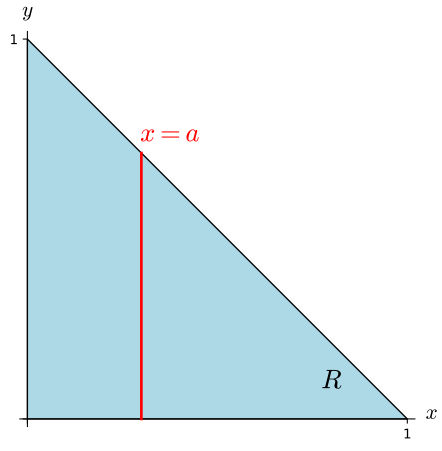
A right triangular region \(R\) in the \(xy\)-plane. The vertices of the triangle are at the origin, \((0,1)\text{,}\) and \((1,0)\text{.}\) There is a vertical line labeled \(x=a\) from the \(x\)-axis to the hypotenuse about one third of the way along the base.
The volume of the tetrahedron can be computed using the double integral
\begin{equation*}
\iint_R 1-(x+y) dA
\end{equation*}
where the region of integration is the triangle at the base of the tetrahedron in the \(xy\)-plane as shown in Figure 12.3.2. We must express this double integral as an iterated integral using the cross-sectional ideas from Section 12.2.
Looking at a cross section along a constant value of \(x=a\) which gives an iterated integral of the form
\begin{equation*}
\int_{x=?}^{x=?} \int_{y=?}^{y=?} 1-(x+y) \, dy \, dx\text{.}
\end{equation*}
Looking at \(R\) along the trace \(x=a\text{,}\) what are the upper and lower bounds on the corresponding \(y\) coordinates?
\begin{equation*}
\text{If }x=a\text{, then } \fillinmath{XXXXX} \leq y \leq \fillinmath{XXXXX}
\end{equation*}
The lower bound does not depend on the value of \(a\text{,}\) but the upper bound does. Hence, the expression for the upper bound should be written in terms of \(a\text{.}\) Write a couple of sentences to describe how you deterined these upper and lower bounds.
(c)
Write a couple of sentences to explain which part of the iterated integral
\begin{equation*}
\int_{x=0}^{x=1} \int_{y=0}^{y=1-x} 1-(x+y) \, dy \, dx
\end{equation*}
corresponds to the blue cross section in Figure 12.3.3.
(d)
Use the Fundamental Theorem of Calculus twice to evaluate the iterated integral
\begin{equation*}
\int_{x=0}^{x=1} \int_{y=0}^{y=1-x} 1-(x+y) \, dy \, dx\text{.}
\end{equation*}
As with iterated integrals over rectangular regions, you evaluate this iterated integral by starting with the inner integral. Compare to your result from part a.

