What surfaces arise as graphs of an equation that contains all three of the variables \(x\text{,}\)\(y\text{,}\) and \(z\) and the equation is quadratic in at least one variable?
In this section, we will introduce some examples of graphs in three dimensions that have nice algebraic properties and a variety of interesting geometric features. In Preview Activity 9.8.1, we ask you to practice identifying conic sections such as circles, parabolas, ellipses, and hyperbolas from their equations. The section will then help you see how to use your knowledge of conic sections to identify key properties of graphs in three dimensions. For a complete discussion of conic sections, see Section A.1.
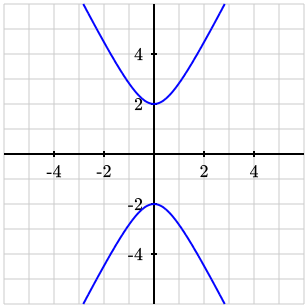
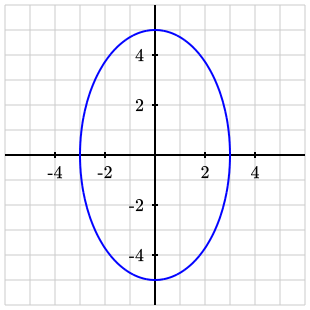
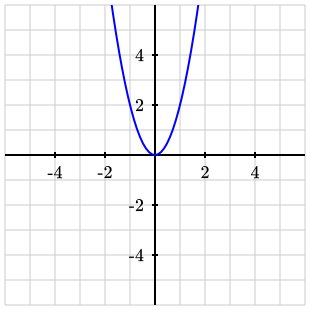
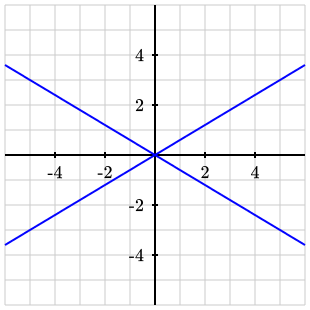
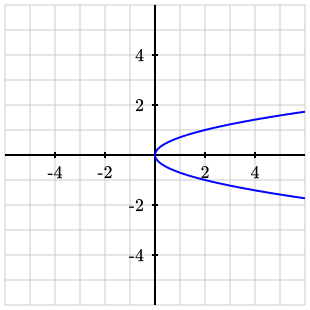
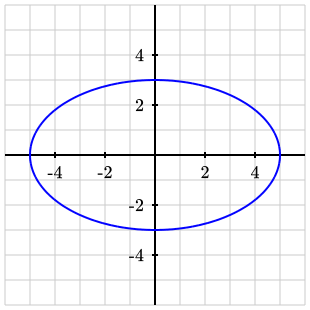
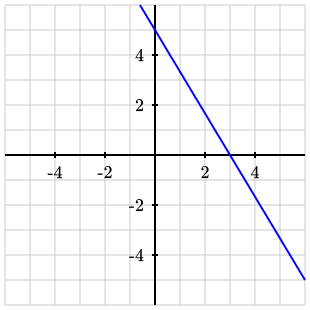
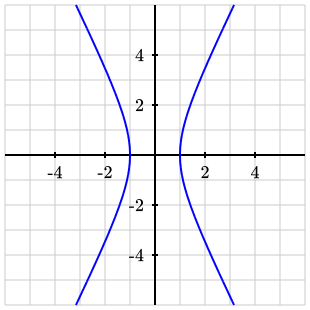
For each equation below, identify its graph in Figure 9.8.1. Note that there are more graphs than equations, so some graphs will not be selected. To help you with identification, you might consider looking for \(x\)-intercepts, \(y\)-intercepts, and values of a variable for which the graph contains no points.
A two dimensional plot with coordinates going from negative six to six including a hyperbola opening toward the top and bottom of the grid. The hyperbola intersects the vertical axis at two and negative two.
A two dimensional plot with coordinates going from negative six to six including an ellipse that is stretched more vertically than horizontally. The ellipse intersects the vertical axis at five and negative five and intersects the horizontal axis at three and negative three.
A two dimensional plot with coordinates going from negative six to six including a parabola opening vertically upward. The parabola intersects axes at the origin and goes through the points \((1,2)\) and \((-1,2)\text{.}\)
A two dimensional plot with coordinates going from negative six to six including a pair of intersecting lines. The intersecting lines go through the origin and go through the additional points \((5,3)\) and \((5,-3)\text{.}\)
A two dimensional plot with coordinates going from negative six to six including a parabola opening horizontally to the right. The parabola intersects axes at the origin and goes through the points \((2,1)\) and \((2,-1)\text{.}\)
A two dimensional plot with coordinates going from negative six to six including an ellipse that is stretched more horizontally than vertically. The ellipse intersects the horizontal axis at five and negative five and intersects the vertical axis at three and negative three.
A two dimensional plot with coordinates going from negative six to six including a hyperbola opening toward the right and left of the grid. The hyperbola intersects the horizontal axis at one and negative one.
Preview Activity 9.8.1 gave you an opportunity to recall that there are a number of interesting curves in the \(xy\)-plane that have nice algebraic forms (equations). What happens if we consider these same equations in three dimensions?
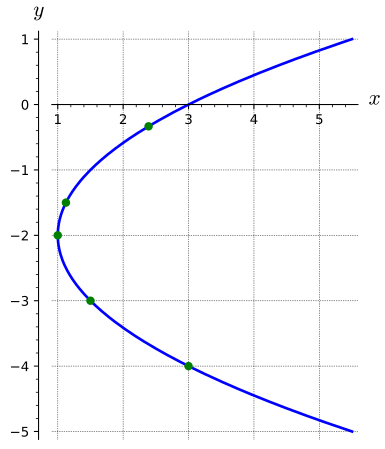
We start by considering \((x-1)=\frac{(y+2)^2}{2}\text{.}\) The graph of \((x-1)=\frac{(y+2)^2}{2}\) in two dimensions is a parabola centered at \((1,-2)\text{.}\)
A two dimensional plot with horizontal coordinates from 1 to 5 and vertical coordinate from negative 5 to positive 1 and includes a plot of a parabola. The parabola is plotted in blue and opens to the right with vertex at \((1,-2)\text{.}\) Four additional points (two with smaller \(y\)-coordinate than the vertex and two with larger \(y\)-coordinate than the vertex) are marked on the graph and plotted in green.
If we want to consider the graph of \((x-1)=\frac{(y+2)^2}{2}\) in three dimensions, then the graph must include all of the \((x,y,z)\) points that will satisfy this equation. For any \(x\) and \(y\) values we pick that satisfy \((x-1)=\frac{(y+2)^2}{2}\text{,}\) we can make any choice of \(z\) to get a point that also satisfies the given equation. Hence, for each of the highlighted points on Figure 9.8.3, we can extend the graph of \((x-1)=\frac{(y+2)^2}{2}\) parallel to the \(z\)-axis, forming a vertical line. Figure 9.8.4 shows how the points on the parabola (in blue) can be extended to include any \(z\)-coordinate.
A three dimensional plot includes a plot of a parabola in the xyplane and five lines that are parallel to the z-axis. The parabola is plotted in blue and opens toward the direction labeled as the x-axis. Four additional points (two with smaller \(y\)-coordinate than the vertex and two with larger \(y\)-coordinate than the vertex) are marked on the graph and plotted in green. Through each of these points is a line drawn parallel to the z-axis.
Extending all points from the parabola \((x-1)=\frac{(y+2)^2}{2}\) in the \(xy\)-plane parallel to the \(z\)-axis will give a surface. This kind of surface is called a cylinder surface. We call the two-dimensional curve used to make the surface the generating curve, and the lines that extend in the direction of the missing variable are called rulings. In Figure 9.8.5, the surface is plotted in blue, the generating curve in black, and the rulings in green. This surface is called a parabolic cylinder surface because the generating curve is a parabola.
A three dimensional plot includes a plot of a parabola in the xy-plane and five lines that are parallel to the z-axis. The parabola is plotted in blue and opens toward the direction labeled as the x-axis. Four additional points (two with smaller \(y\)-coordinate than the vertex and two with larger \(y\)-coordinate than the vertex) are marked on the graph and plotted in green. Through each of these points is a line drawn parallel to the z-axis. A curved surface that goes through the parabola and the green lines is drawn in gray.
The next activity prompts you to look at the most important cylinder surfaces. The conic sections that were reviewed in Preview Activity 9.8.1 will be helpful as you do this.
Each equation below is a cylinder surface in \(\R^3\text{.}\) To sketch the cylinder surfaces in \(xyz\)-space, you should first draw the generating curve in the \(xy\)-plane, \(xz\)-plane, or \(yz\)-plane (depending on which two variables appear in the equation) and then sketch a three-dimensional cylinder surface by thinking about how the rulings will run.
The defining characteristic of the equations of cylinder surfaces is that one variable is completely omitted from the equation. Now we will examine surfaces with algebraic equations that are quadratic in \(x\text{,}\)\(y\text{,}\) and \(z\text{.}\) This will give us a category of example surfaces that are simple algebraically but exhibit a variety of interesting and important characteristics. To understand these quadric surfaces, we focus on the intercepts and two-dimensional graphs formed by the intersection of the quadric surface with fundamental planes. Next activity leads you through this process to help you learn to recognize and sketch quadric surfaces. After this, we will summarize the key ideas for recognizing and sketching quadric surfaces and then you will have the opportunity to apply those key ideas in additional activities.
For this activity, we will be looking at a variety properties that will help us draw a graph of the surface described by \(\frac{x^2}{4}+\frac{y^2}{9}-\frac{z^2}{1}=1\text{.}\)
Find an equation for the curve given by the intersection of \(\frac{x^2}{4} + \frac{y^2}{9} - \frac{z^2}{1} = 1\) with the \(xy\)-plane, the \(yz\)-plane, and the \(xz\)-plane. Draw a two-dimensional plot of each intersection.
Find equations for the curve given by the intersection of \(\frac{x^2}{4}+\frac{y^2}{9}-\frac{z^2}{1}=1\) with the each of the following fundamental planes. You should state the shape and any other characteristics (like center or direction) for each of these intersections.
Which of the following surface plots will correspond to \(\frac{x^2}{4}+\frac{y^2}{9}-\frac{z^2}{1}=1\text{?}\) You can determine this by comparing the features on your previous part to these options.
An interactable three dimensional plot with five options in a drop down menu. The first option is labeled Surface 1 and plots an ellipsoid in light blue with an ellipse shown on the xyplane in red, an ellipse shown in the yz-plane in blue, and an ellipse in the xz-plane shown in green. The second option is labeled Surface 2 and plots a curved surface centered along the x-axis in light blue with an hyperbola shown on the xy-plane in red, an ellipse shown in the yz-plane in blue, and a hyperbola the xz-plane shown in green. The third option is labeled Surface 3 and plots a curved surface centered along the y-axis in light blue with a hyperbola shown on the xy-plane in red, a hyperbola shown in the yz-plane in blue, and an ellipse in the xz-plane shown in green. The fourth option is labeled Surface 4 and plots a curved surface centered along the z-axis in light blue with an ellipse shown on the xy-plane in red, a hyperbola shown in the yz-plane in blue, and a hyperbola the xz-plane shown in green. The fifth option is labeled Surface 5 and plots a cone centered along the z-axis in light blue with a pair of intersecting lines shown in the yz-plane in blue and another pair of intersecting lines in the xz-plane shown in green.
In designing Activity 9.8.3, we carefully chose the fundamental planes for which we asked you to find the intersection with the surface. By examining the equation that defines a surface, you can strategically select fundamental planes to investigate. Doing so will allow you to identify key characteristics of a quadric surface without needing to test an exceedingly large number of fundamental planes. In Key Idea 9.8.11, we suggest some steps to follow. Afterward, you will have an activity that gives you a chance to practice implementing these steps.
Identify the intercepts of the surface with the \(x\)-axis, \(y\)-axis, and \(z\)-axis, including noting if the surface does not intersect one or more of these coordinate axes. To find the intercepts, set two of the variables equal to \(0\) and solve for the third.
Identify the intersection curve of the surface with the \(xy\)-plane, \(yz\)-plane, and \(xz\)-plane, including noting if the surface does not intersect one or more of these coordinate planes. To find these intersections, set one variable equal to \(0\) and manipulate the equation so that you can recognize the shape of the curve. In most cases, the curve will be a conic section, and you should pay particular attention to the intercepts of the conic section.
Identify the intersection curve of the surface with at least two fundamental planes parallel to each of the three coordinate planes. To find these intersections, set a variable equal to a nonzero constant and manipulate the equation so that you can recognize the shape of the curve. In most cases, the curve will be a conic section, and you should pay particular attention to the intercepts of the conic section.
Practice will help you develop a strategy for choosing these constants, but the following suggestions will be helpful as you are practicing:
Use what you learned in the two prior steps. For example, if a surface doesn’t intersect the \(xy\)-plane (\(z=0\)), find values of \(z\) that do create intersections with fundamental planes.
Determine if the shape of the intersection varies depending on the value you choose for a fixed coordinate. For example, if all intersections with planes of the form \(x=c\) are hyperbolas, do some values of \(c\) cause the hyperbolas to have intercepts on one axis while other values of \(c\) cause the hyperbolas to have intercepts on another axis? If there are variations of this form, identify them as best as you can.
To illustrate parts of Key Idea 9.8.11, we can return to Activity 9.8.3 and discuss some of our strategy in selecting the fundamental planes we asked you to consider:
For planes of the form \(z=c\text{,}\) the intersection equation is always of the form \(\frac{x^2}{4}+\frac{y^2}{9} = 1+c^2\text{,}\) which gives an ellipse for all values of \(c\text{.}\)
For planes of the form \(x=c\text{,}\) the intersection equation is \(\frac{y^2}{9}-z^2 = 1-\frac{c^2}{4}\text{.}\) When \(c^2/4 \lt 1, \text{,}\) this is a hyperbola with positive coefficient on the \(y^2\) term. This hyperbola has intercepts on the \(y\)-axis. When \(c^2/4\gt 1\text{,}\) the right-hand side of the equation is negative, so a more standard form for the equation would be \(z^2-\frac{y^2}{9} = \frac{c^2}{4}-1\text{,}\) which is a hyperbola that has intercepts on the \(z\)-axis.
For planes of the form \(y=c\text{,}\) the intersection equation is \(\frac{x^2}{4}-z^2 = 1-\frac{c^2}{9}\text{.}\) As with planes of the form \(x=c\text{,}\) these are hyperbolas where the location of the intercepts depends on the sign of \(1-\frac{c^2}{9}\text{.}\)
For each equation below, use the process in Key Idea 9.8.11 to determine the shape of the quadric surface defined by the equation and identify the graph of the quadric surface in Figure 9.8.12.
An interactable three dimensional plot with five options in a drop down menu. The first option is labeled Surface 1 and plots a curved surface centered along the z-axis in light blue with an ellipse shown on the xy-plane in red, a hyperbola shown in the yz-plane in blue, and a hyperbola the xz-plane shown in green. The second option is labeled Surface 2 and plots a curved surface in light blue centered at the origin that increases parabolically in the z-coordinate along constant values of y. This surface curves down in terms of z-coordinates along constant values of x. Additionally, a pair of intersecting lines is shown on the xy-plane in red, a parabola bending down is shown in the yz-plane in blue, and a parabola pointing up in the xz-plane is shown in green. The third option is labeled Surface 3 and plots a cone centered along the z-axis in light blue with a pair of intersecting lines shown in the yz-plane in blue and another pair of intersecting lines in the xz-plane shown in green. The fourth option is labeled Surface 4 and plots a curved surface in light blue centered at the origin that increases parabolically in the z-coordinate as the x and y coordinates move away from the origin. Additionally, an upward facing parabola is shown in the yz-plane in blue, and a parabola pointing up in the xz-plane is shown in green. The fifth option is labeled Surface 5 and plots a hyperboloid of two sheets in light blue. This plot shows two bowl shaped parts separated along the x-axis with a hyperbola shown on the xy-plane in red and a hyperbola the xz-plane shown in green. The sixth option is labeled Surface 6 and plots an ellipsoid in light blue with an ellipse shown on the xyplane in red, an ellipse shown in the yz-plane in blue, and an ellipse in the xz-plane shown in green.
As mentioned before, the surfaces given by \(\frac{x^2}{4}+\frac{y^2}{9}+\frac{z^2}{1}=1\text{,}\)\(\frac{x^2}{4}+\frac{y^2}{9}-\frac{z^2}{1}=1\text{,}\)\(\frac{x^2}{4}-\frac{y^2}{9}-\frac{z^2}{1}=1\text{,}\) and \(\frac{x^2}{4}-\frac{y^2}{9}-\frac{z}{1}=1\) are examples of quadric surfaces. Quadric surfaces are the surfaces generated by polynomials that are quadratic in at least one of the three coordinate variables: \(x\text{,}\)\(y\text{,}\) and \(z\text{.}\) There are six main shapes of quadric surfaces. The box below gives the forms of the equations of these. Figure 9.8.13 shows plots of each of the main shapes with the algebraic form used to describe each shape. Note that all of these examples are oriented along the \(z\)-axis and centered at the origin. However, as with conic sections, quadric surfaces can be oriented along other coordinate directions and/or centered away from the origin.
The following is a list of the six types of quadric surfaces and their general algebraic form centered at the origin with stretches of \(a\text{,}\)\(b\text{,}\) and \(c\) in the respective coordinate directions. Each of these is oriented along the \(z\)-axes (when possible).
An interactable three dimensional plot with seven options in a drop down menu. The first option is labeled Ellipsoid and plots a curved surface centered at the origin in light blue with an ellipse shown on the xy-plane in red, an ellipse shown on the yz-plane in blue, and an ellipse shown on the xz-plane shown in green. Other ellipses are parallel to each of the coordinate planes. The second option is labeled Hyperboloid of One Sheet and plots a curved surface in light blue centered along the z-axis. Hyperbolas are shown parallel to the xz-plane in green and parallel to the yz-plane in blue. Ellipses are shown parallel to the xy-plane in red. The third option is labeled Hyperboloid of Two Sheets and plots a curved surface in light blue centered along the z-axis with a gap centered at the origin. Hyperbolas are shown parallel to the xz-plane in green and parallel to the yz-plane in blue. Ellipses are shown parallel to the xy-plane in red. The fourth option is labeled Elliptic Paraboloid and plots a bowl shaped surface that curves toward the positive z-axis. Parabolas are shown parallel to the xz-plane in green and parallel to the yz-plane in blue. Ellipses are shown parallel to the xy-plane in red. The fifth option is labeled Saddle/Hyperbolic Paraboloid and plots a curved surface that forms parabolically in the z-coordinate along constant values of y. This surface curves down in terms of z-coordinates along constant values of x. Parabolas are shown parallel to the xz-plane in green and parallel to the yz-plane in blue. Hyperbolas are shown parallel to the xy-plane in red. The sixth option is labeled Alt Saddle and plots a curved surface that forms parabolically in the z-coordinate along constant values of y. This surface curves down in terms of z-coordinates along constant values of x. Parabolas are shown parallel to the xz-plane in green and parallel to the yz-plane in blue. Hyperbolas are shown parallel to the xy-plane in red. The seventh option is labeled Cone and plots a cone centered along the z-axis. Parabolas are shown parallel to the xz-plane in green and parallel to the yz-plane in blue. Ellipses are shown parallel to the xy-plane in red.
In Chapter 11, we will talk about surfaces where one coordinate can be expressed as a function of the others. This is an extension of the idea that graphs that pass the vertical line test can be expressed with \(y\) as a function of \(x\text{.}\) For instance, in the plot of the saddle surface shown in Figure 9.8.13, any line parallel to the \(z\)-axis will intersect the saddle surface at only one place. This means that the saddle surface can be expressed with \(z\) as a function of \(x\) and \(y\text{.}\) This is not surprising since the saddle surface is given by \(\frac{x^2}{a^2}-\frac{y^2}{b^2}=z\text{.}\) Further discussion of writing one variable as a function of the others can be found in Exercise 9.2.5.9 and Section 11.2.
Compare this to the graph of a hyperboloid of one sheet in Figure 9.8.13, where a line that is parallel to the \(z\)-axis will intersect the surface at two places. Lines parallel to the \(x\)- or \(y\)-axes will also intersect the hyperboloid of one sheet in more than one place. This means that we cannot express the graph of a hyperboloid of one sheet with one of the coordinates as a function of the other two. Algebraically, this corresponds to there being more than one solution when you try to solve the equation \(\frac{x^2}{a^2}+\frac{y^2}{b^2}-\frac{z^2}{c^2}=1\) for one variable. In particular, the multiple solutions come from needing to consider the positive and negative square roots. We will return to this idea in Chapter 11.
Hyperbola: \(\frac{(x-h)^2}{a^2}-\frac{(y-k)^2}{b^2}=1\) with center \((h,k)\text{,}\) vertices \((h\pm a,k)\text{,}\) and asymptotes \((y-k)=\frac{b}{a}(x-h)\)
Cylinder surfaces are described algebraically by an equation involving only two coordinate variables. Geometrically, a cylinder surface is generated by a curve/graph in the coordinate plane involving the two coordinate variables in the equation and stretching this generating curve parallel to the missing coordinate variable’s axis.
Quadric surfaces are a category of surfaces created by quadratic equations in \(x\text{,}\)\(y\text{,}\) and \(z\text{.}\) Quadric surfaces have six typical shapes: ellipsoid, hyperboloid of one sheet, hyperboloid of two sheets, elliptic paraboloid, hyperbolic paraboloid (saddle surface), and cone. The same coordinate transformations that generalize conic sections can be applied to quadric surfaces.
Identify the following surfaces as an elliptical paraboloid, hyperbolic paraboloid, a hyperboloid of one sheet, a hyperboloid of two sheets, a cone, a circular cylinder, an elliptical cylinder, or a parabolic cylinder, and identify the axis of symmetry as the x-axis, the y-axis, or the z-axis.
In this exercise, we will look at a few different surfaces and the algebraic forms used to translate the center or key feature of the surface. In particular, we will look at spheres, cones, and a parabolic cylinder surface with translations away from the origin.
We need to start with a description of the key features of our surface. For a sphere, you need to state the center and radius since the surface is going to be complete described by these two features. Write a sentence that gives the center and radius for the sphere given by \(x^2+y^2+z^2=1\text{.}\)
We need to start with a description of the key features of our surface. For a cone, you need to state the center (where the vertex of the cone occurs) and the axis of symmetry that the cone is centered on, since the cone is going to be complete described by these two features. Write a sentence that gives the center and axis of symmetry for the cone given by \(x^2+y^2=z^2\text{.}\)
We need to start with a description of the key features of our surface. For a parabolic cylinder surface, you need to state the plane with the generating curve and the features of the generating curve, since the surface is going to be complete described by these two features. Write a couple of sentences to describe this cylinder surface given by \(y=x^2\text{.}\) Be sure to include which plane contains the generating curve and the important features of the generating curve. You should also state which axis the rulings will be parallel to.
Give the equation for a parabolic cylinder surface with generating curve in the yz-plane, with vertex of the generating parabola at \((0,-2,4)\text{,}\) and parabola extending in the negative z direction.
In this exercise, we will look at how stretches of each coordinate direction appear algebraically as a transformation of our quadric and cylinder surfaces.
For the sphere given by \(x^2+y^2+z^2=16\text{,}\) describe how the surface is stretched (relative to the center) in each of the coordinate directions.
What kind of surface is given by \(\frac{x^2}{9}+\frac{y^2}{4}+z^2=1\text{.}\) Give the shape of the surface and how it is stretched relative to the basic sphere in the previous task.
Give the equation of an ellipsoid with center \((1,2,3)\) that has been stretched by a by a factor of 6 parallel to the x-axis, by a factor of 2/3 parallel to the y-direction, and by a factor of \(\pi\) parallel to the z-direction.
For the hyperboloid of one-sheet given by \(x^2+y^2-z^2=1\text{,}\) describe how the surface is stretched (relative to the center) in each of the coordinate directions. You should also give the coordinate axis that describes the axis of symmetry/rotation for this hyperboloid.
For the hyperboloid of one-sheet given by \(\frac{x^2}{9}+\frac{y^2}{4}-z^2=1\text{,}\) describe how the surface is stretched (relative to the center) in each of the coordinate directions. You should also give the coordinate axis that describes the axis of symmetry/rotation for this hyperboloid.
Give the equation of a hyperboloid of one sheet centered on the y-axis that has been stretched by a factor of five parallel to the x-axis and by a factor of \(\frac{6}{7}\) parallel to the z-axis.
How would the description of the surface given by \(\frac{(x-2)^2}{25}+\frac{(z-\pi)^2}{\frac{36}{49}}-\frac{y^2}{4}=1\) be different than the surface from the previous task
Using your newly found understanding of cylinder and quadric surfaces, for each equation given below, write a couple sentences to describe the shape and key features of each surface. You should try to draw a good plot of each equation by hand and label your graphs.