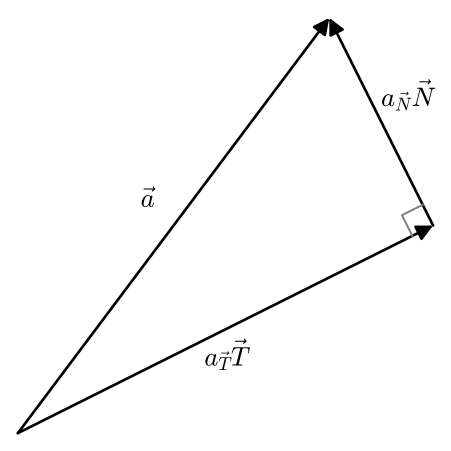
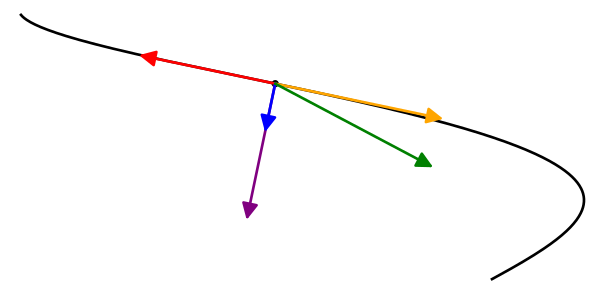
We claim that the scalar \(a_{\vN}\) measures the acceleration due to change in the direction of \(\vv\) and the scalar \(a_{\vT}\) measures the acceleration due to the change in magnitude of \(\vv\text{.}\) This interpretation of \(a_{\vT}\) and \(a_{\vN}\) follows from a product rule argument based on how we split the velocity vector into speed (magnitude) and \(\vT\) (direction). We start by splitting velocity into its direction and magnitude:
\begin{equation*}
\vv(t) = \text{speed}(t) \cdot \vT(t)
\end{equation*}
Taking the derivative of the velocity using a product rule, we get the following formula for acceleration:
\begin{equation*}
\va(t) = \frac{d\vv}{dt} = \frac{d}{dt}(\text{speed}) \cdot \vT + (\text{speed}) \cdot \frac{d}{dt}(\vT)
\end{equation*}
We can rearrange the terms in our definition for \(\vN\) to solve for \(\vT\, '(t)\text{,}\) which gives
\begin{equation*}
\vN=\frac{\vT\, '}{\vecmag{\vT\, '}} \Rightarrow \vT\, '= \vecmag{\vT'} \vN \text{.}
\end{equation*}
Applying this to our acceleration equation above, we get
\begin{equation}
\va(t) = \frac{d\vv}{dt} = \frac{d}{dt}(\text{speed}) \cdot \vT + (\text{speed}) \cdot \vecmag{\frac{d\vT}{dt}} \vN \text{.}\tag{10.7.1}
\end{equation}
This algebraic splitting of acceleration gives a nice way to interpret
\(a_{\vT}\text{.}\) Specifically,
\(a_{\vT}\) is the rate of change of speed!
The scalar
\(a_{\vN}\) is harder to interpret right now because our algebraic splitting shows that
\(a_{\vN} = (\text{speed}) \vecmag{\frac{d\vT}{dt}}\text{.}\) Since
\(\frac{d\vT}{dt}\) and
\(\vecmag{\frac{d\vT}{dt}}\) are as hard to calculate directly as
\(\vN\) is, we do not yet have an intuitive interpretation for the meaning of
\(a_{\vN}\text{.}\) We will return to the meaning of
\(a_{\vN}\) later in this section, but for now you should think of
\(a_{\vN}\) as the acceleration due to a change in the direction of the velocity vector. In other words,
\(a_{\vN}\) is the amount of acceleration due to turning.