This section extends the tools of Section 12.4 to functions of three variables to define triple integrals. While these ideas are geometrically challenging to students (finding bounds of integration and visualization of volumes in three dimensions), many students understand the algebraic mechanics of evaluating iterated integrals of this section quickly and without much prompting.
In this chapter, we defined the double integral of a continuous function \(f = f(x,y)\) over a rectangle \(R = [a,b] \times [c,d]\) as a limit of a double Riemann sum, which paralleled the definition of a single-variable integral for a function \(g = g(x)\) on an interval \([a,b]\text{.}\) We have also repeatedly emphasized the interpretations and applications of the double integral as stated in Key Idea 12.2.8. These ideas will naturally extend to functions with more than two variables, but the geometric elements of these extensions become harder to visualize. In the Preview Activity below, we will setup a Riemann sum as an approximation to integrating a function of three variables (step 1 of a classic calculus approach).
In this activity, we want to try to estimate the mass of large piece of granite. Granite is composed of different minerals such as feldspar and quartz that give distinctive patterns of color and texture. The large piece of granite we are looking at is 4 feet wide, six feet deep, and 8 feet tall which we will describe by
\begin{equation*}
B = \{(x,y,z) : 0 \leq x \leq 4, 0 \leq y \leq 6, 0 \leq z \leq 8\}\text{.}
\end{equation*}
This very special piece of granite formed in a region with many geological folds and has its density given by \(\delta(x,y,z)= 163+3\sin(xy)+\frac{2z}{3}\text{.}\) The units for \(x,y,z\) are measured in feet and the density is given in pounds per cubic foot.
For a solid of constant density, we can find the mass by multiplying the density and volume. For our block of granite, the density varies from point to point based on the function \(\delta(x,y,z)\text{.}\) In this activity, we will approximate the mass of the block (step 1 of the classic calculus approach) by slicing the solid into smaller pieces on which there are smaller density changes and thus the density is closer to constant.
A plot of a box-shaped region in three dimensions. The box has one corner at the origin and the diagonally opposite corner is at \((4,6,8)\text{.}\) The box is partitioned into smaller boxes by one horizontal plane, one vertical plane parallel to the \(yz\)-plane, and two vertical planes parallel to the \(xz\)-plane.
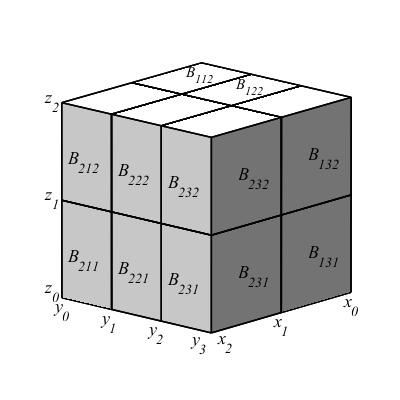
Let \(0=x_0 \lt x_1 \lt x_2=4\) be the endpoints of the \(x\)-subintervals of \([0,4]\) after partitioning. Label these endpoints on Figure 12.7.2. Repeat this process with \(0=y_0 \lt y_1 \lt y_2 \lt y_3=6\) and \(0=z_0 \lt z_1 \lt z_2=8\text{.}\)
An array of three dimensional boxes split into three parts from left to right, two parts top to bottom, and two parts from front to back. Faces of these boxes are labeled and the division points are labeled \(y_0,y_1,y_2,y_3\) from left to right, \(x_2,x_1,x_0\) from front to back, and \(z_0,z_1,z_2\) from bottom to top.
Our partitions of the \(x,y,z\)-intervals created sub-boxes for our granite block. How many sub-boxes were created and what is the volume of the sub-boxes?
For each sub-box, pick a point in that region and evaluate the density function at that point. Make sure you note what point you chose and the density at that point.
For each sub-box, multiply the density at your chosen point by the volume of the sub-box to get an estimate of the mass for the sub-box. Sum over all of your sub-boxes to give an estimate of the mass for the entire block, which will complete step 1 of the classic calculus approach to measuring the total mass of our granite block.
We partitioned our block, the space of inputs for \(\delta(x, y, z)\text{,}\) into a relatively small number of pieces. Write a couple of sentences about what you would change in the process above to improve the approximation of the mass of the block. Be sure to explain why your changes will give a better approximation.
In the Preview Activity, we completed step 1 and justified step 2 of the, classic calculus approach toward integrating a density function in three dimensions. The generalization of our work in the previous part of this chapter on double integrals works much as you would expect, so we be brief in our statements of these generalizations and will spend the rest of this section getting used to the mechanics and geometric arguments that are typical in these types of problems.
Subsection12.7.2Triple Riemann Sums and Triple Integrals
Through the application of a mass density distribution over a three-dimensional solid block of granite, Preview Activity 12.7.1 suggests a natural generalization from double Riemann sums of functions of two variables to triple Riemann sums of functions of three variables. In the same way, we can generalize from double integrals to triple integrals. By simply adding a \(z\)-coordinate to our earlier work, we can define both a triple Riemann sum and the corresponding triple integral.
Let \(f = f(x,y,z)\) be a continuous function on a box \(B = [a,b] \times [c,d] \times [r,s]\text{.}\) The triple Riemann sum of \(f\) over \(B\) is created as follows.
Partition the \(x\)-interval \([a,b]\) into \(m\) subintervals of equal length, the \(y\)-interval \([c,d]\) into \(n\) subintervals of equal length, and the \(z\)-interval \([r,s]\) into \(\ell\) subintervals of equal length.
For each sub-box created by this partition, let \(P_{ijk}\) be a point in the \(i\)-th segment of \(x\text{,}\) the \(j\)-th segment of \(y\text{,}\) and \(k\)-th segment of \(z\text{.}\) The volume of each sub-box is \(\frac{1}{mn\ell}\) of the total volume.
If \(f(x,y,z)\) represents the density of a material in the box \(B\text{,}\) then as we saw in Preview Activity 12.7.1, the triple Riemann sum approximates the total mass of material in the box \(B\) as step 1 of our classic calculus approach. In order to find the exact mass of the box, we will need to let the number of sub-boxes increase without bound (in other words, let \(m\text{,}\)\(n\text{,}\) and \(\ell\) go to infinity). When we do this, the finite sum of the mass approximations becomes the exact mass of the solid \(B\text{.}\) More generally, we have the following definition of the triple integral.
In the above description, we used equally spaced division of each of the coordinates to separate the region of integration into pieces. As the number of pieces increases (\(m\text{,}\)\(n\text{,}\) and \(\ell\) go to infinity), the volume of each piece (\(\Delta V\)) will go to zero. A more general treatment of this process will show that the pieces do not need to be the same size, but the size of all of the pieces must approach zero in the limit used for the triple Riemann sum.
Just as we did with double integrals, we will use a series of iterated integrals to efficiently evaluate our triple integrals. As you might expect, the volume element \(dV\) is \(dz \, dy \, dx\) in rectangular coordinates, since we measure the volume of a box as the height times the width times the depth. Thus, a triple integral of a function \(f\) over a box \(B = [a,b] \times [c,d] \times [r,s]\) in rectangular coordinates can be evaluated as an iterated integral of the form
\begin{equation*}
\iiint_B f(x,y,z) \, dV = \int_a^b \int_c^d \int_r^s f(x,y,z) \, dz \, dy \, dx.
\end{equation*}
Set up and evaluate an iterated integral that will evaluate the triple integral of \(f(x,y,z) = x-y+2z\) over the box \(B = [-2,3] \times [1,4] \times [0,2]\text{.}\)
Remember that it was our descriptions of two dimensional regions of integration using inequalities corresponding to horizontally or vertically simple regions that allowed us to convert double integrals into iterated integrals. We will generalize this process to three dimensional regions of integration in order to convert triple integrals into three iterated integrals where the order in which state the bounds on each coordinate corresponds to the order in which variables are integrated. In the next example, we will describe the process of setting up these inequalities, then using three iterated integrals to calculate the triple integral of a three variable function over a region that does not have constant coordinate bounds.
In this example, we will find the mass of the tetrahedron \(S\) in the first octant bounded by the coordinate planes and the plane \(x + 2 y + 3 z = 6\) if the density at point \((x,y,z)\) is given by \(\delta(x, y, z) = x + y + z\text{.}\) A picture of the solid tetrahedron is shown in Figure 12.7.6.
The tetrahedron in three-dimensional space. Three sides of the tetrahedron are triangular regions in the coordinate planes, and the fourth side is the triangle with vertices \((6,0,0)\text{,}\)\((0,3,0)\text{,}\) and \((0,0,2)\text{.}\)
We find the mass \(M\) of the tetrahedron using the triple integral
\begin{equation*}
M = \iiint_S \delta(x,y,z) \, dV\text{.}
\end{equation*}
To do this, we will need to generalize our ideas from Section 12.4 and describe \(S\) using three sets of inequalities, one for each variable. In this example, we choose to integrate with respect to \(z\) first for the innermost integral. We will first need to consider how to give bounds on the “top” and “bottom” functions for \(z\) as a function of \(x\) and \(y\text{.}\) In other words, we need to give functions \(z=g(x,y)\) and \(z=h(x,y)\) such that for any \((x,y)\) point in our region, \(g(x,y)\) will give the largest \(z\)-value we need to consider and \(h(x,y)\) will need to give the smallest \(z\)-value. This description will give us an iterated integral of the form
Note that the inner integral will be considered with \(x\) and \(y\) held constant and \(D\) being the set of \((x,y)\) points over which our three dimensional region of integration sits.
You can see from Figure 12.7.6 that the plane containing the points \((6,0,0),(0,3,0),(0,0,2)\) will give us \(z=g(x,y)\) and the \(xy\)-plane will give us \(z=h(x,y)\text{.}\) So we have
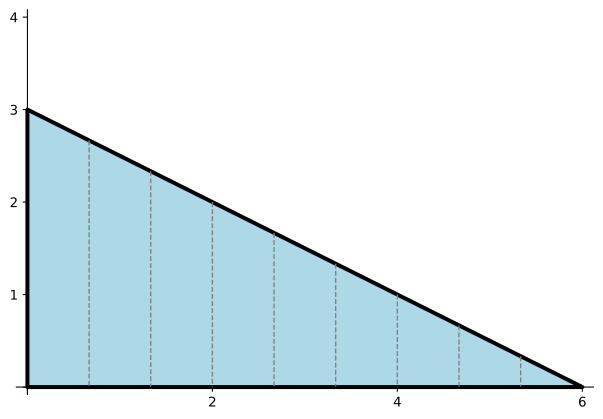
as our first iterated integral. We now need to consider \(D\text{,}\) the region of the \(xy\)-plane over which our region \(S\) sits. In this example, \(D\) coincides with the triangle in the \(xy\) plane with vertices \((0,0),(6,0),(0,3)\text{,}\) as drawn in Figure 12.7.7.
In order to complete our transformation to iterated integrals, we need to describe \(D\) as either horizontally simple or vertically simple. We can see that \(D\) is both vertically simple and horizontally simple, so we could use either description. In this example, we chose to describe the region as vertically simple, as suggested by the dashed lines in Figure 12.7.7. We will cut our region into vertical slices for \(0\leq x\leq 6\text{.}\) Furthermore, the lower bound on each slice is \(y=0\text{,}\) so we just need to find the equation of the top boundary of the region. We can find the equation of the line that determines this top boundary as \(x + 2 y = 6 \text{.}\) Solving for \(y\) gives \(y = 3 - \frac{1}{2}x\text{.}\) Therefore, we can describe the base of the tetrahedron as a vertically simple region using the inequalities
A shaded triangular region in the \(xy\)-plane. The triangle has vertices \((0,0)\text{,}\)\((6,0)\text{,}\) and \((0,3)\text{.}\) There are dashed vertical lines shown inside the region.
With our description of \(S\) in terms of inequalities in hand, we can write an iterated triple integral to find the mass of the tetrahedron by integrating the density function \(\delta(x,y,z)=x+y+z\text{:}\)
\begin{equation}
M = \int_{0}^{6} \int_{0}^{3-(1/2)x} \int_{0}^{(1/3)(6-x-2y)} (x+y+z) \, dz \, dy \, dx\text{.}\tag{12.7.1}
\end{equation}
Let \(S\) be the solid cone bounded by \(z = \sqrt{x^2+y^2}\) and \(z=3\text{.}\) The goal of this activity is to set up an iterated integral of the form
to represent the mass of \(S\) in the setting where \(\delta(x,y,z)\) tells us the density of \(S\) at the point \((x,y,z)\text{.}\) In particular, we must find the limits on each of the three integrals.
A picture of \(S\) is shown in Figure 12.7.8. Adjust the sliders, which will move the vertical line segment shown inside the solid. Notice that some combinations of slider values show a red point and no line segment, as the point \((x,y)\) does not correspond to any points inside the solid.
A solid in three-dimensional space. The solid is bounded below by an upward-opening cone with its vertex at the origin. The solid is bounded above by a horizontal plane. There are sliders for \(x\) and \(y\) that control the location of a vertical line segment from the bottom of the solid to the top of the solid over the point \((x,y)\text{.}\)
For the innermost integral of equation (12.7.2), we need bounds on the \(z\)-coordinate for fixed values of \(x\) and \(y\text{.}\) In Figure 12.7.8, you can use the sliders to change the values of \(x\) and \(y\text{.}\) When your choices of \(x\) and \(y\) correspond to points inside the solid, you see a vertical line segment in the plot from the bottom of the solid to the top of the solid over the point \((x,y)\) in the \(xy\)-plane.
Try several values of \(x\) and \(y\text{.}\) Look at how the length of the segment changes in the \(z\)-direction. In particular, for every \(x\) and \(y\) pair, the bottom boundary of the solid is the same. Similarly, for every pair of values the top boundary of the solid is the same surface. This allows you to use functions, in terms of \(x\) and \(y\text{,}\) that describe the top and bottom boundaries of the solid. These are the \(z\)-coordinates of the points at the top and bottom of the vertical line segments through the solid shown in the figure.
Having established upper and lower bounds for \(z\) as a function of a fixed choice of \(x\) and \(y\text{,}\) we need to describe the set of points \((x,y)\) in the \(xy\)-plane such that a vertical line through \((x,y)\) will pass through the solid. Notice that if you choose values of \(x\) and \(y\) in Figure 12.7.8 that does not intersect the solid (e.g., \((x,y)=(2.6,-2.3)\)), then the point is shown in red.
You can see from Figure 12.7.8 that there will be \(x\) and \(y\) values from \(-3\) to \(3\) that will correspond to points in our solid. It is tempting to give the region of the \(xy\)-plane we need to consider using the inequalities \(-3\leq x\leq 3\) and \(-3\leq y\leq 3\text{.}\) Write a couple of sentences to explain why the set of \((x,y)\) points we need to consider is not the square \([-3,3]\times[-3,3]\text{.}\)
On Figure 12.7.9, draw a plot of \(D\text{,}\) the region of \((x,y)\) points that correspond to points of \(S\text{.}\) We refer to \(D\) as the projection of \(S\) onto the \(xy\)-plane.
\begin{equation*}
\iiint_S \delta(x,y,z) dV
\end{equation*}
as an iterated integral, you need to describe the region \(D\) from the previous part using inequalities, as with double integrals. Do this using a vertically simple description in order to have your iterated integral fit the form of equation (12.7.2).
We did not evaluate the three iterated integrals in the previous activity because the bounds of integration stated would give iterated integrals that turn out to be difficult to do by hand. You may have noticed that the region in Activity 12.7.3 would be easily described in cylindrical coordinates and might yield more convenient bounds of integration. We will look at this type of transformation for triple integrals in Section 12.8.
Algebraic Note: When setting up iterated integrals, the limits on a given variable can be only in terms of constants and the variable(s) whose integral(s) are outside that integral in the iterated integral. In addition, there are multiple different ways we can choose to set up such an integral. For example, two possibilities for iterated integrals that represent a triple integral \(\iiint_S f(x,y,z) \, dV\) over a solid \(S\) are
where \(g_1\text{,}\)\(g_2\text{,}\)\(h_1\text{,}\)\(h_2\text{,}\)\(p_1\text{,}\)\(p_2\text{,}\)\(q_1\text{,}\) and \(q_2\) are functions of the indicated variables. There are four other options beyond the two stated here, since the variables \(x\text{,}\)\(y\text{,}\) and \(z\) can, in theory, be arranged in any order. In many circumstances, an insightful choice of variable order will make it easier to set up an iterated integral, just as was the case when we worked with double integrals.
Setting up limits on iterated integrals often requires considerable geometric intuition. It is important not only to create carefully labeled figures for the region of integration, but also to think about how we wish to slice the solid region of inputs for a triple integral. Further, note that when we say “we will integrate first with respect to \(x\text{,}\)” by “first” we are referring to the innermost integral in the iterated integral. The next activity explores several different ways we might set up the integral in Example 12.7.5.
Set up an iterated integral, integrating first with respect to \(z\text{,}\) then \(x\text{,}\) then \(y\) that is equivalent to the integral in equation (12.7.1). Before you write down the integral, think about Figure 12.7.6 and draw a plot of the appropriate projection.
After considering the upper and lower bound surfaces in terms of \(z\text{,}\) you will need to project onto the \(xy\)-plane and think of this projection as a horizontally simple region.
Set up an iterated integral, integrating first with respect to \(y\text{,}\) then \(z\text{,}\) then \(x\text{,}\) that is equivalent to the integral in equation (12.7.1). As above, think carefully about the geometry first and draw a plot of the appropriate projection.
Set up an iterated integral, integrating first with respect to \(x\text{,}\) then \(y\text{,}\) then \(z\) that is equivalent to the integral in equation (12.7.1).
As described earlier, if \(f(x, y, z)\) represents the density of the solid \(B\) at each point \((x, y, z)\text{,}\) then
\begin{equation*}
M = \iiint_B f(x,y,z) \, dV
\end{equation*}
is the mass of \(B\text{.}\) Even more importantly, for any continuous function \(f\) over the solid \(B\text{,}\) we can use a triple integral to determine the average value of \(f\) over \(B\text{,}\)\(f_{\operatorname{AVG}(B)}\text{.}\) We note this generalization of our work with functions of two variables along with several others in Key Idea 12.7.10. Note that each of these quantities may actually be considered over a general domain \(S\) in \(\R^3\text{,}\) not simply a box, \(B\text{.}\)
If \(S\) has density given by \(\delta = \delta(x,y,z)\text{,}\) then the center of mass \((\overline{x}, \overline{y}, \overline{z})\) can be computed as
\begin{align*}
\overline{x} \amp = \frac{\iiint_S x \ \delta(x,y,z) \, dV}{M},\\
\overline{y} \amp = \frac{\iiint_S y \ \delta(x,y,z) \, dV}{M}, \\
\overline{z} \amp = \frac{\iiint_S z \ \delta(x,y,z) \, dV}{M},
\end{align*}
The next activity asks you to practice setting up triple integrals as iterated integrals, including thinking about the interpretations of Key Idea 12.7.10.
A solid \(S\) is bounded below by the paraboloid \(z=x^2+y^2\) and above by the sphere \(x^2+y^2+z^2=6\text{.}\) A picture of \(S\) is shown in Figure 12.7.11.
A three-dimensional plot of a solid region. The solid is bounded below by a surface that rises from the origin and has circles as its horizontal cross-sections. It is bounded above by the top portion of the sphere \(x^2+y^2+z^2=6\text{.}\)
You need to find three compound inequalities that bound \(x\text{,}\)\(y\text{,}\) and \(z\) to get your limits of integration. You may find it helpful to recall the approach of Activity 12.7.3 and imagine a line segment through \(S\) (parallel to the axis of the inner most variable). When finding the bounds on \(x\) and \(y\text{,}\) you will also likely find it helpful to set up your inequalities in terms of \(x^2+y^2\text{.}\)
Suppose the density at point \((x,y,z)\) is \(\delta(x,y,z)=x^2+1\text{.}\) Set up, but do not evaluate, the necessary iterated integrals to find the center of mass of \(S\text{.}\)
Use technology to evaluate the iterated triple integrals you wrote in the other three parts of this activity. Write a couple of sentences to explain why the location of the center of mass makes sense.
Iterated integrals can be used to efficiently evaluate triple integrals by bounding surfaces in one coordinate, then projecting the solid region onto the remaining coordinate plane. There are six different orders of integration possible in terms of rectangular coordinates.
If \(S\) has density given by \(\delta = \delta(x,y,z)\text{,}\) then the center of mass \((\overline{x}, \overline{y}, \overline{z})\) can be computed as
\begin{align*}
\overline{x} \amp = \frac{\iiint_S x \ \delta(x,y,z) \, dV}{M},\\
\overline{y} \amp = \frac{\iiint_S y \ \delta(x,y,z) \, dV}{M}, \\
\overline{z} \amp = \frac{\iiint_S z \ \delta(x,y,z) \, dV}{M},
\end{align*}
Let \(W_1\) be the solid half-cone bounded by \(z=\sqrt{x^2+y^2}\text{,}\)\(z=4\) and the \(yz\)-plane with \(x \le 0\text{,}\) and let Let \(W_2\) be the solid half-cone bounded by \(z=\sqrt{x^2+y^2}\text{,}\)\(z=4\) and the \(xz\)-plane with \(y \ge 0\text{.}\)
Without calculation, decide if each of the integrals below are positive, negative, or zero. Let W be the solid bounded by \(z = \sqrt{x^2 + y^2}\) and \(z = 2\text{.}\)
Find the triple integral of the function \(f(x,y,z) = x^{3}\cos\mathopen{}\left(y+z\right)\) over the cube \(6 \leq x \leq 7\text{,}\)\(0 \leq y \leq \pi\text{,}\)\(0 \leq z \leq \pi.\)
Find the average value of the function \(f \left( x, y, z \right) = x^{2} + y^{2} +
z^{2}\) over the rectangular prism \(0 \leq x \leq 1, \ \
0 \leq y \leq 4, \ \ 0 \leq z \leq 5\text{.}\)
Express the integral \(\displaystyle \iiint_E f(x,y,z) dV\) as an iterated integral in six different ways, where E is the solid bounded by \(z =0, x = 0, z = y - 3 x\) and \(y = 12\text{.}\)
Find the volume of the solid enclosed by the paraboloids \(z = 4 \left(
x^{2} + y^{2} \right)\) and \(z = 18 - 4 \left( x^{2} + y^{2}
\right)\text{.}\)
Rewrite the triple integral \(\displaystyle \int_0^1 \int_0^x \int_0^y
f(x,y,z) dz dy dx\) as \(\displaystyle \int_a^b
\int_{g_1(z)}^{g_2(z)} \int_{h_1(y,z)}^{h_2(y,z)}f(x,y,z) dx dy dz\)
Integrate \(f(x,y,z)=18 xz\) over the region in the first octant \((x,y,z\ge 0)\) above the parabolic cylinder \(z=y^2\) and below the paraboloid \(z=8-2x^2-y^2\text{.}\)
Evaluate the triple integral \(\displaystyle \iiint_T x^2 \, dV,\) where \(T\) is the solid tetrahedron with vertices \((0,0,0),\)\((3,0,0),\)\((0,3,0),\) and \((0,0,3).\)
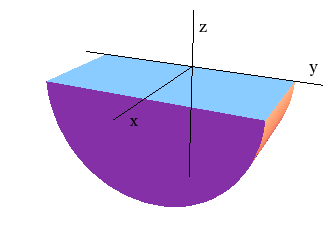
Write limits of integration for the integral \(\int_W g(x,y,z)\,dV\text{,}\) where \(W\) is the half cylinder shown, if the length of the cylinder is 1 and its radius is 1.
Find the mass of the rectangular prism \(0 \leq x \leq 3, \ \ 0
\leq y \leq 4, \ \
0 \leq z \leq 3\text{,}\) with density function \(\rho \left( x, y, z \right) = x\text{.}\)
Find the average value of the function \(f \left( x, y, z \right) = y e^{-xy}\) over the rectangular prism \(0 \leq x \leq 4\text{,}\)\(0 \leq y \leq 3\text{,}\)\(0 \leq z \leq 1\)
Find the mass of the solid bounded by the \(xy\)-plane, \(yz\)-plane, \(xz\)-plane, and the plane \((x/4)+(y/4)+(z/16) = 1\text{,}\) if the density of the solid is given by \(\delta (x,y,z)=x + 4 y\text{.}\)
The moment of inertia of a solid body about an axis in 3-space relates the angular acceleration about this axis to torque (force twisting the body). The moments of inertia about the coordinate axes of a body of constant density and mass \(m\) occupying a region \(W\) of volume \(V\) are defined to be
Use these definitions to find the moment of inertia about the \(z\)-axis of the rectangular solid of mass \(9\) given by \(0 \le x \le 1\text{,}\)\(0 \le y \le 3\text{,}\)\(0 \le z \le 3\text{.}\)
The motion of a solid object can be analyzed by thinking of the mass as concentrated at a single point, the center of mass. If the object has density \(\rho(x,y,z)\) at the point \((x,y,z)\) and occupies a region \(W\text{,}\) then the coordinates \((\overline{x},\overline{y},\overline{z})\) of the center of mass are given by
Assume \(x\text{,}\)\(y\text{,}\)\(z\) are in cm. Let \(C\) be a solid cone with both height and radius 2 and contained between the surfaces \(z=\sqrt{x^2+y^2}\) and \(z=2\text{.}\) If \(C\) has constant mass density of 4 g/cm\(^3\text{,}\) find the \(z\)-coordinate of \(C\)’s center of mass.
Set up a triple integral to find the mass of the solid tetrahedron bounded by the xy-plane, the yz-plane, the xz-plane, and the plane \(x/4 + y/3 + z/12 = 1\text{,}\) if the density function is given by \(\delta(x,y,z) = x + y\text{.}\) Write an iterated integral in the form below to find the mass of the solid.
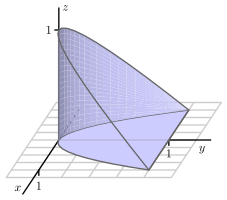
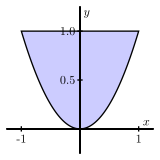
Set up (but do not evaluate) an iterated integral that represents the mass of \(S\text{.}\) Integrate first with respect to \(z\text{,}\) then \(y\text{,}\) then \(x\text{.}\) A picture of the projection of \(S\) onto the \(xy\)-plane is shown at left in Figure 12.7.13.
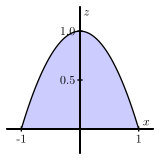
Set up (but do not evaluate) an iterated integral that represents the mass of \(S\text{.}\) In this case, integrate first with respect to \(y\text{,}\) then \(z\text{,}\) then \(x\text{.}\) A picture of the projection of \(S\) onto the \(xz\)-plane is shown at center in Figure 12.7.13.
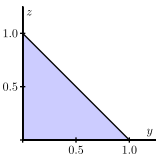
Set up (but do not evaluate) an iterated integral that represents the mass of \(S\text{.}\) For this integral, integrate first with respect to \(x\text{,}\) then \(y\text{,}\) then \(z\text{.}\) A picture of the projection of \(S\) onto the \(yz\)-plane is shown at right in Figure 12.7.13.
Set up, but do not evaluate, an iterated integral expression whose value is the average sum of all real numbers \(x\text{,}\)\(y\text{,}\) and \(z\) that have the following property: \(y\) is between 0 and 2, \(x\) is greater than or equal to 0 but cannot exceed \(2y\text{,}\) and \(z\) is greater than or equal to 0 but cannot exceed \(x+y\text{.}\)
Set up, but do not evaluate, an integral expression whose value represents the average value of \(f(x,y,z) = x + y + z\) over the solid region in the first octant bounded by the surface \(z = 4 - x - y^2\) and the coordinate planes \(x=0\text{,}\)\(y=0\text{,}\)\(z=0\text{.}\)
Set up, but do not evaluate, an iterated integral expression whose value determines the mass of the solid, integrating first with respect to \(z\text{,}\) then \(y\text{,}\) then \(x\text{.}\) Assume the the solid’s density is given by \(\delta(x,y,z) = \frac{1}{x^2 + y^2 + z^2 + 1}\text{.}\)
Set up, but do not evaluate, iterated integral expressions whose values determine the mass of the solid using all possible remaining orders of integration. Use \(\delta(x,y,z) = \frac{1}{x^2 + y^2 + z^2 + 1}\) as the density of the solid.
Set up, but do not evaluate, iterated integral expressions whose values determine the center of mass of the solid. Again, assume the the solid’s density is given by \(\delta(x,y,z) = \frac{1}{x^2 + y^2 + z^2 + 1}\text{.}\)
Consider the solid created by the region enclosed by the circular paraboloid \(z = 4 - x^2 - y^2\) over the region \(R\) in the \(xy\)-plane enclosed by \(y = -x\) and the circle \(x^2 + y^2 = 4\) in the first, second, and fourth quadrants. Determine the solid’s volume.
Consider the solid region that lies beneath the circular paraboloid \(z = 9 - x^2 - y^2\) over the triangular region between \(y = x\text{,}\)\(y = 2x\text{,}\) and \(y = 1\text{.}\) Assuming that the solid has its density at point \((x,y,z)\) given by \(\delta(x,y,z) = xyz + 1\text{,}\) measured in grams per cubic cm, determine the center of mass of the solid.
In a certain room in a house, the walls can be thought of as being formed by the lines \(y = 0\text{,}\)\(y = 12 + x/4\text{,}\)\(x = 0\text{,}\) and \(x = 12\text{,}\) where length is measured in feet. In addition, the ceiling of the room is vaulted and is determined by the plane \(z = 16 - x/6 - y/3\text{.}\) A heater is stationed in the corner of the room at \((0,0,0)\) and causes the temperature in the room at a particular time to be given by
Consider the solid enclosed by the cylinder \(x^2 + y^2 = 9\) and the planes \(y + z = 5\) and \(z = 1\text{.}\) Assuming that the solid’s density is given by \(\delta(x,y,z) = \sqrt{x^2 + y^2}\text{,}\) find the mass and center of mass of the solid.