Because we choose to cover polar coordinates in the chapter on the precalculus of multivariable functions, this section jumps right into how polar coordinates work in double integrals and provide some computational advantages. If you did not cover Section 9.8 when teaching Chapter 9, you will need to cover at least the subsection on polar coordinates before teaching this section. The preview activity in this section helps students recall important elements of points, graphs, and regions in polar coordinates before we apply the same slicing and iterated integral techniques as in Section 12.3.
This section has only two activities (plus the preview activity). For instructors who introduced polar coordinates in Chapter 9, it will be easy to cover this section in a single class meeting. Instead of having more activities in this section, we encourage instructors to reinforce that cylindrical coordinates are “polar coordinates with \(z\)” so that the section on triple integrals in cylindrical coordinates can also help students build skills in this area.
While we have defined double integrals in the rectangular coordinate system, starting with domains that are rectangular regions, there are many of these integrals that are difficult, if not impossible, to evaluate. For example, if \(D\) is the unit disc centered at the origin and \(f(x,y) = e^{-x^2 - y^2}\text{,}\) then integrating \(f\) over \(D\) would use the iterated integral
For this particular integral, we are unable to find an antiderivative of the integrand. Changing the order of integration does not help, as the region and the integrand are symmetric in \(x\) and \(y\text{.}\) Furthermore, even if we could find an antiderivative, the inner limits of integration involve relatively complicated functions.
This example shows that it can be useful to be able to translate to other coordinate systems where the limits of integration and the evaluation of the iterated integrals are simpler. In this section we provide a brief reminder of polar coordinates and then investigate their usage for double integrals. For a more thorough discussion of polar coordinates, refer to Subsection 9.8.2.
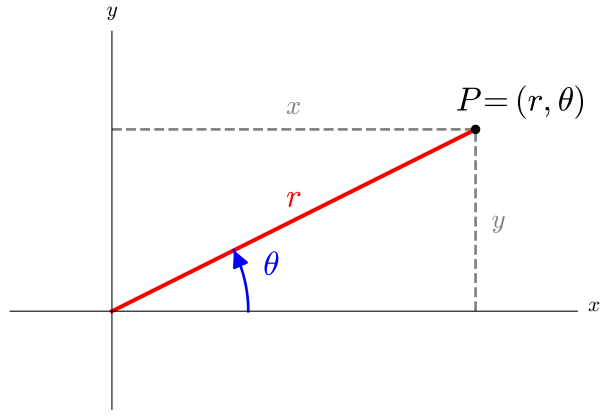
The rectangular coordinate system is best suited for graphs and regions that are naturally considered over a rectangular grid. The polar coordinate system is an alternative that offers good options for functions and domains that have more circular characteristics. Recall that a point \(P\) in rectangular coordinates that is described by an ordered pair \((x,y)\text{,}\) where \(x\) is the displacement from \(P\) to the \(y\)-axis and \(y\) is the displacement from \(P\) to the \(x\)-axis can also be described with polar coordinates \((r,\theta)\text{,}\) where \(r\) is the distance from \(P\) to the origin and \(\theta\) is the angle formed by the line segment \(\overline{OP}\) and the positive \(x\)-axis, as shown in Figure 12.5.1.
A two dimensional plot with the horizontal axis labeled \(x\text{,}\) the vertical axis labeled \(y\text{,}\) and a point in the first quadrant labeled \(P=(r,\theta)\text{.}\) There is a line segment going from the origin to \(P\text{.}\) The line segment is labeled \(r\text{.}\) An arc is shown going counterclockwise from the horizontal axis to the line segment and is labeled \(\theta\text{.}\) There is a dashed vertical line segment labeled \(y\) from the horizontal axis to \(P\text{.}\) There is a dashed horizontal line segment labeled \(x\) from the vertical axis to \(P\text{.}\)
Trigonometry and the Pythagorean Theorem allow for straightforward conversion from rectangular to polar, and vice versa. A reminder of these formulas, which were developed in Subsection 9.8.2, is included below.
Recall that when considering polar coordinates, it is important to think about how the sign of \(r\) influences the position of a point. There are also multiple angle measurements in polar coordinates that can be used for a single point, so it will be helpful to think flexibly about ranges of \(\theta\) when describing regions in polar coordinates. Refer to Example 9.8.12 and later examples for different ways to interpret and make conversions between rectangular and polar coordinates.
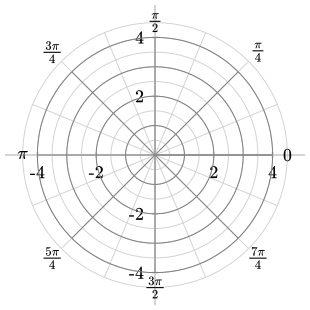
We can draw graphs of curves in polar coordinates in a similar way to how we do in rectangular coordinates. However, when plotting in polar coordinates, we use a grid that considers changes in angles and changes in distance from the origin. In particular, the angles \(\theta\) and distances \(r\) partition the plane into small wedges as shown in Figure 12.5.2.
A two-dimensional plot of the polar coordinate grid. Concentric circles centered at the origin are shown with radius increasing in half unit increments. Rays emanante from the origin between the horizontal and vertical axes. In each quadrant, there are three rays between the axes. The middle of each of these rays is marked \(\pi/4\text{,}\)\(3\pi/4\text{,}\)\(5\pi/4\text{,}\) and \(7\pi/4\text{,}\) working counterclockwise starting in the first quadrant. The positive horizontal axis is marked \(0\text{,}\) the positive vertical axis is marked \(\pi/2\text{,}\) the negative horizontal axis is marked \(\pi\text{,}\) and the negative vertical axis is marked \(3\pi/2\text{.}\)
For each of the following polar equations, draw a plot in the plane of the curve. Write a sentence for each graph to explain why the equation is satisfied.
\begin{equation*}
\iint_D e^{x^2+y^2} \, dA
\end{equation*}
where \(D\) is the unit disk. While we cannot directly evaluate this integral in rectangular coordinates, a change to polar coordinates will convert it to one we can easily evaluate.
We have seen how to evaluate a double integral \(\displaystyle \iint_D f(x,y) \, dA\) as an iterated integral of the form
\begin{equation*}
\int_a^b \int_{g_1(x)}^{g_2(x)} f(x,y) \, dy \, dx
\end{equation*}
in rectangular coordinates where \(D\) has a vertically simple description with \(a\leq x \leq b\) and \(g_1(x) \leq y \leq g_2(x)\text{.}\) Note that the area element \(dA\) became \(dy\, dx \) in this conversion of the double integral into an iterated integral. We will need to complete three steps to transform this double integral into polar coordinates:
The second and third of these steps are already things we have discussed in the context of understanding polar coordinates. However, understanding how to write the area element \(dA\) in polar coordinates is a new topic. To do this, we focus on how the area element \(dA\) can be written in terms of \(dr\) and \(d\theta\) in the context of polar coordinates.
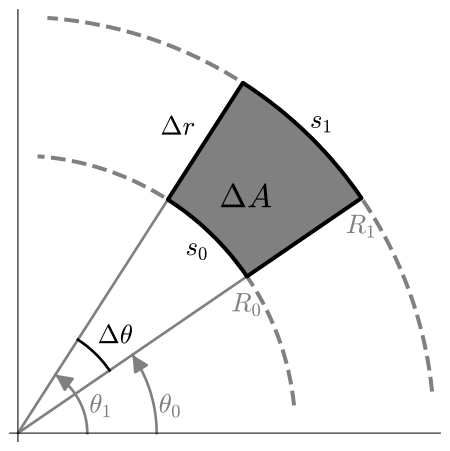
Remember that the classic calculus approach to defining the double integral involved breaking each coordinate into smaller pieces which created a collection of smaller (rectangular) regions that we used to create our Riemann sum. We can do the same procedure in terms of polar coordinates, and we could have our smaller pieces be in terms of some small changes in \(r\) and \(\theta\text{,}\) such as the regions on the polar grid in Figure 12.5.2. Notice how, in that image, even though the changes in \(r\) and \(\theta\) used to define the grid are all the same, a region farther from the origin has larger area than one closer to the origin. This suggests that understanding how to measure the area of a piece described by \(R_0\leq r \leq R_1 \quad \theta_0 \leq \theta \leq \theta_1\text{,}\) as shown in Figure 12.5.4, will be more complicated than in rectangular coordinates.
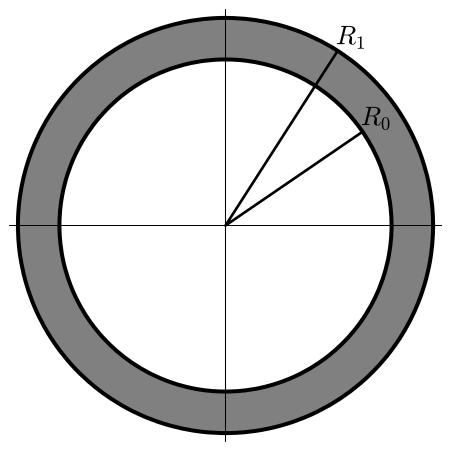
We will first consider the area of the annulus between \(r=R_0\) and \(r=R-1\text{,}\) shown in Figure 12.5.3. The area of this region is the difference between the area of a disk of radius \(R_1\) and the area of a disk of radius \(R_0\text{:}\)
A plot of two circles in the plane. Both circles are centered at the origin. The circles have radii marked as \(R_0\) and \(R_1\text{,}\) with \(R_0 \lt R_1\text{.}\) The region between the circles is shaded.
We want to measure the area of the portion of the annulus satisfying \(\theta_0 \leq \theta \leq \theta_1\text{.}\) Let \(\Delta \theta=\theta_1-\theta_0\) be the change in the theta coordinate for the small piece for which we want to find the area. Because we are using radian measures for angles, the portion of the annulus we are considering is \(\frac{\Delta \theta}{2\pi}\text{.}\) This means that the area of this small piece will be
\begin{equation*}
\Delta A = \frac{\Delta \theta}{2\pi} \left(\pi\left(R_1^2-R_0^2\right)\right)\text{.}
\end{equation*}
A two-dimensional plot in the first quadrant of a region in polar coordinates. The diagram includes two dashed circular arcs with radii labeled as \(R_0\) and \(R_1\) and \(R_0\lt R_1\text{.}\) There are also two rays emanating from the origin. The measures of the angles formed by these rays and the horizontal axis are marked as \(\theta_0\) and \(\theta_1\) with \(\theta_0 \lt \theta_1\text{.}\) The angle between the rays is labled \(\Delta \theta\text{.}\) The region between the circular arcs and rays is shaded and labeled \(\Delta A\text{.}\) The side of the shaded region lying on the circular arc of radius \(R_0\) is labeled \(s_0\text{.}\) The side of the shaded region lying on the circular arc of radius \(R_1\) is labeled \(s_1\text{.}\) One side of the shaded region lying on a ray is labeled \(\Delta r\text{.}\)
where \(\Delta r = R_1-R_0\text{.}\) Note that as \(\Delta r \) gets smaller, \(R_1\) and \(R_0\) get closer to the same value, which means that
\begin{equation*}
\Delta A \approx R_1 \Delta r \, \Delta \theta\text{.}
\end{equation*}
Since we can easily convert the function \(f(x,y)\) to polar coordinates with the conversion equations to be \(f(r\cos(\theta),r\sin(\theta))\text{,}\) we can then approximate a double integral \(\iint_D f(x,y) \, dA\) with a Riemann sum of the form
Notice that here, instead of the \(\Delta x\, \Delta y\) that we had in a Riemann sum using rectangular coordinates, our integrand is multiplied by \(r_i^*\, \Delta r\, \Delta \theta\text{.}\) This leads us to the realization that we will need to use \(dA = r\, dr\, d\theta\) when writing a double integral as an iterated integral in polar coordinates.
This leaves only the second conversion step: convert the region of integration described by inequalities that correspond to fixing one coordinate and bounding the other in a consistent way. Similar to how we used vertically simple and horizontally simple descriptions for rectangular regions, we want to set up inequalities by hold one of our coordinates constant and setting boundary functions for the other coordinate.
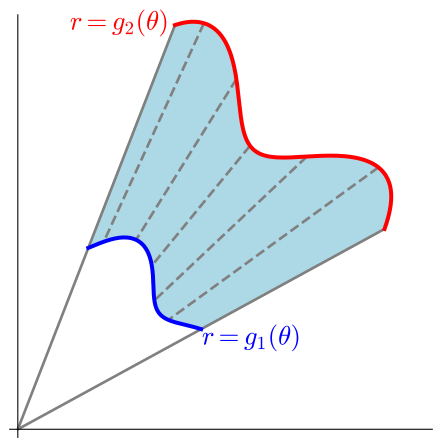
A two-dimensional plot of a shaded region in the first quadrant. The region is bounded by two rays emanating from the origin as well as two wavy curves. The angles these rays make with the positive horizontal axis are labeled as \(a\) and \(b\) with \(a\lt b\text{.}\) The curve closer to the origin is labeled \(r=g_1(\theta)\text{.}\) The curver farther from the origin is labeled \(r=g_2(\theta)\text{.}\) There are dashed line segments drawn through the region in a manner that suggests they are the portion of rays emanating from the origin that lie inside the region.
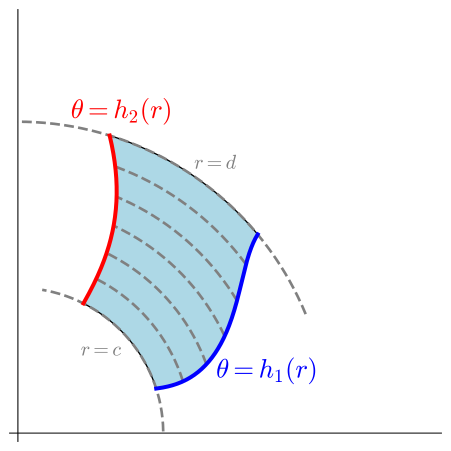
A two-dimensional plot of a shaded region in the first quadrant. The region is bounded by two arcs of circles centered at the origin. The arc closer to the origin is labeled \(r=c\text{.}\) The arc farther from the origin is labeled \(r=d\text{.}\) The other boundaries of the region are wavy curves joining the circular arcs. The bounding curve with smaller \(\theta\) values is labeled \(\theta=h_1(r)\text{.}\) The other bounding curve is labeled \(\theta=h_2(r)\text{.}\) There are dashed circular arcs drawn through the region in a manner that suggests they are the portions of circles centered at the origin that lie inside the region.
Each of the types of regions above corresponds to exactly the necessary description to use a iterated integral. With a radially simple region, for any fixed value of \(\theta\) in the interval \([a,b]\text{,}\) a slice along this constant \(\theta\) value corresponds to a ray from the origin in the sector between the grey lines in Figure 12.5.6. Along this ray with \(\theta=k\text{,}\) the region of interest has upper and lower bounds on the \(r\)-coordinate. In fact, \(r=g_2(\theta)\) describes the upper boundary for every value of \(\theta\) in \([a,b]\text{.}\) Similarly, \(r=g_1(\theta)\) describes the lower boundary for every value of \(\theta\) in \([a,b]\text{.}\) Geometrically, this means that along every gray dashed slice where \(\theta\) is constant, the region has the same upper and lower boundary curves, shown in red and blue, respectively.
While angularly simple regions are used less frequently than radially simple regions, a parallel structure is used. Along every slice with a constant value of \(r\) in \([c,d]\text{,}\) represented bythe gray, dashed curves in Figure 12.5.7, the upper bound on \(\theta\) is given by the function \(\theta=h_2(r)\) and the lower bound is given by \(\theta=h_1(r)\text{,}\) shown by the red and blue bounding curves in Figure 12.5.7.
Just as in the rectangular coordinate case, especially complicated regions may need to be split into several different regions that are radially or angularly simple.
The double integral \(\iint_D f(x,y) \, dA\) in rectangular coordinates can be converted to a double integral in polar coordinates as \(\iint_D f(r\cos(\theta), r\sin(\theta)) \, r \, dr \, d\theta\text{.}\)
Note again that the order of integration corresponds to the manner in which we have sliced the region of integration. The variable being held constant along a slice is the last variable to be integrated, just as was the case with iterated integrals in rectangular coordinates.
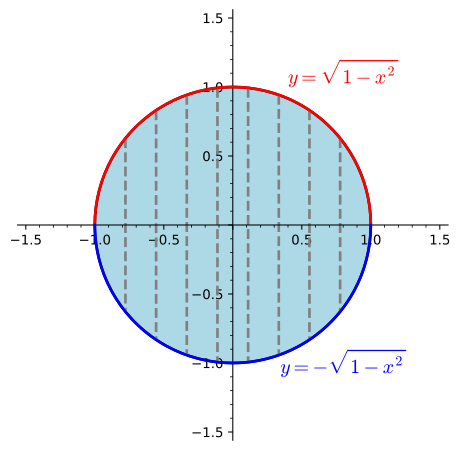
Let \(f(x,y) = e^{x^2+y^2}\) on the disk \(D = \{(x,y) : x^2 + y^2 \leq 1\}\text{.}\) Our goal in this example is to evaluate \(\displaystyle \iint_D f(x,y) \, dA\text{.}\)
A two-dimensional plot of a shaded region in the \(xy\)-plane. The region is a disc of radius \(1\) centered at the origin. The upper semicircle bounding the disc is labeled \(y=\sqrt{1-x^2}\text{.}\) The lower semicircle bounding the disc is labeled \(y=-\sqrt{1-x^2}\text{.}\) There are vertical dashed lines throughout the region.
We cannot evaluate this iterated integral because \(e^{x^2 + y^2}\) does not have an elementary antiderivative with respect to either \(x\) or \(y\text{.}\) However, since \(r^2=x^2+y^2\) and the region \(D\) is circular, it is natural to wonder whether converting to polar coordinates will allow us to evaluate the new integral. To do so, we replace \(x\) with \(r \cos(\theta)\text{,}\)\(y\) with \(r \sin(\theta)\text{,}\) and \(dy \, dx\) with \(r \, dr \, d\theta\) to obtain
\begin{equation*}
\iint_D f(x,y) \, dA = \iint_D e^{r^2} \, r \, dr \, d\theta\text{.}
\end{equation*}
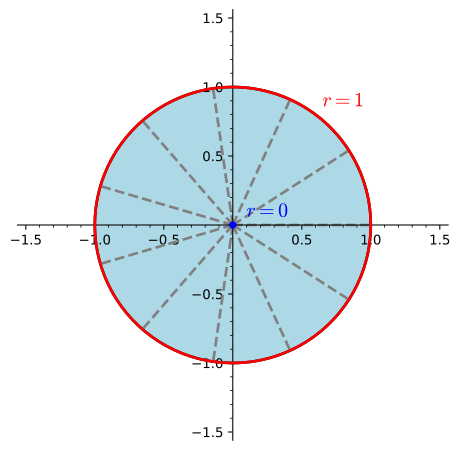
The disc \(D\) is described in polar coordinates by the inequalities \(0 \leq r \leq 1\) and \(0 \leq \theta \leq 2\pi\text{.}\) Note that the region \(D\) can be considered both radially simple and angularly simple since all of the bounds of integration are constant. Figure 12.5.10 shows how \(D\) can be considered radially simple.
A two-dimensional plot of a shaded region in the plane. The region is a disc of radius \(1\) centered at the origin. The circle bounding the disc is labeled \(r=1\text{.}\) The origin is labeled \(r=0\text{.}\) There are dashed rays emanating from the origin through the region.
While there is no firm rule for when polar coordinates can or should be used, they are a natural alternative anytime the domain of integration may be expressed simply in polar form and/or when the integrand involves expressions such as \(\sqrt{x^2 + y^2}\text{.}\)
Evaluate one of the iterated integrals. Write a couple sentences to interpret your answer in the context of a double integral (e.g., as either a signed volume or an average value).
In the next activity, you will convert an equation from rectangular to polar coordinates and use this polar equation to give bounds of integration for two different integrals.
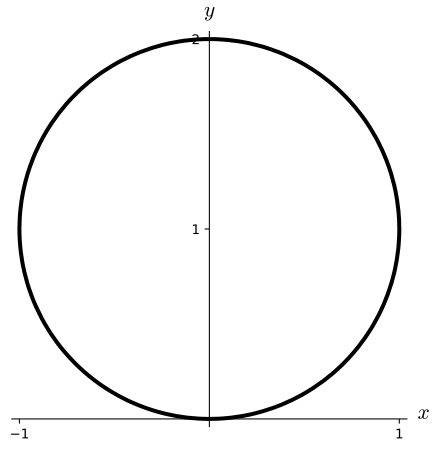
Determine a polar curve in the form \(r = f(\theta)\) that traces out the circle \(x^2 + (y-1)^2 = 1\text{.}\) To do this, you should substitute \(x = r \cos(\theta)\) and \(y = r \sin(\theta)\) into the rectangular coordinate equation and solve for \(r\text{.}\)
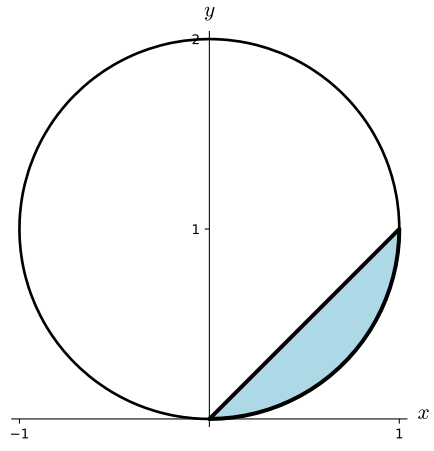
Find the volume under the surface \(h(x,y) = x\) over the region \(D\text{,}\) where \(D\) is the region bounded above by the line \(y=x\) and below by the circle. We have provided a sketch of this as the shaded region in Figure 12.5.12.
A shaded region in the \(xy\)-plane. The region is bounded by part of a circle and the portion of the line \(y=x\) inside the circle. The circle passes through the origin and the point \((0,2)\text{.}\) The circle is also symmetric about the \(y\)-axis.
To convert the double integral \({\displaystyle\iint_D f(x,y) \, dA}\) to an iterated integral in polar coordinates, we substitute \(r \cos(\theta)\) for \(x\text{,}\)\(r \sin(\theta)\) for \(y\text{,}\) and \(r \, dr \, d\theta\) for \(dA\) to obtain the iterated integral (where the order of integration is determined by whether the region is described as radially or angularly simple)
\begin{equation*}
{\iint_D f(r\cos(\theta), r\sin(\theta)) \, r \, dr \, d\theta}
\end{equation*}
For each of the following, set up the integral of an arbitrary function \(f(x,y)\) over the region in whichever of rectangular or polar coordinates is most appropriate. (Use \(t\) for \(\theta\) in your expressions.)
Using polar coordinates, evaluate the integral which gives the area which lies in the first quadrant between the circles \(x^2 + y^2 = 4\) and \(x^2 - 2x + y^2 = 0\text{.}\)
(a) Graph \(r=1/(3\cos\theta)\) for \(-\pi/2\le\theta\le\pi/2\) and \(r=1\text{.}\) Then write an iterated integral in polar coordinates representing the area inside the curve \(r=1\) and to the right of \(r=1/(3\cos\theta)\text{.}\) (Use \(t\) for \(\theta\) in your work.)
Using polar coordinates, evaluate the integral \(\displaystyle \int \!\! \int_{R} \sin (x^2+y^2) dA\) where R is the region \(1 \leq x^2 + y^2 \leq 64\text{.}\)
Instructions: Please enter the integrand in the first answer box, typing theta for \(\theta\text{.}\) Depending on the order of integration you choose, enter dr and dtheta in either order into the second and third answer boxes with only one dr or dtheta in each box. Then, enter the limits of integration.
Find the exact center of mass of the lamina over the portion of \(D\) that lies in the first quadrant and has its mass density distribution given by \(\delta(x,y) = 1\text{.}\) (Before making any calculations, where do you expect the center of mass to lie? Why?)